

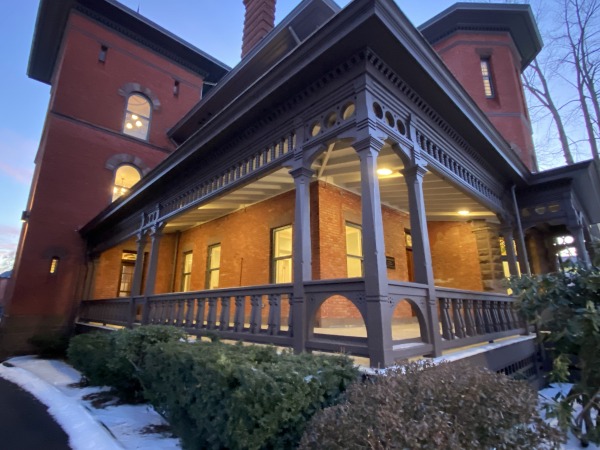
The Plimpton family lived in the house from 1879 until 1946, and so the simplest answer to this question is that it's named for them. Historic and architectural references to the house usually call it "the Linus B. Plimpton House," because Linus purchased the house in 1879, owned it until his death in 1904 (at which point title passed to his daughters Julia, Mary, and Grace), and because he was a locally prominent businessman and politician. For a time, the house was known as "the Mansion House," which was the name given by Florence Savoy to the senior living facility that she maintained here during the 1970s and 1980s, but after the South Park Inn bought the house in 1990, they renamed it "the Plimpton House," and that name, without specific reference to Linus, is how the house is commonly known today around Asylum Hill.
Local lore has it that Linus Bacon and Samuel Clemens used to play billiards in this room, and generally speaking that is why the room is now referred to as the "billiard room." The room does resemble the room on the third floor of the Mark Twain House, where Clemens had his desk and a pool table, and that could be the source of this story. Did Linus and Sam have any verifiable connections? Apparently, Clemens designed a notebook that Plimpton Manufacturing Company then custom made for him, but that doesn't necessarily mean that they knew each other. Both men were Republicans -- although Clemens became a mugwump after a time. And while the Clemenses were members of Asylum Hill Congregational Church, it appears that only the women of the Plimpton household were members of AHCC -- Linus may have instead been a member of Center (First) Congregational Church instead.
This is a recent discovery. Mary Plimpton and Grace Plimpton were two of the five founding members of the Musical Club of Hartford, and this club was formed in part to provide opportunities for women to study music and to perform for an audience. In the earliest years of the club, meetings and performances rotated among the houses of the members, and it struck as at least possible that some of these performances were held in this room.